A mosque’s progress is determined by more than the grandeur of its building, the number of facilities, or the funds available. The way its organizers think is equally important.
Organizers with the right mindset see limitations as challenges to address. Even comprehensive facilities may deliver limited benefits without vision, courage, and a commitment to service.
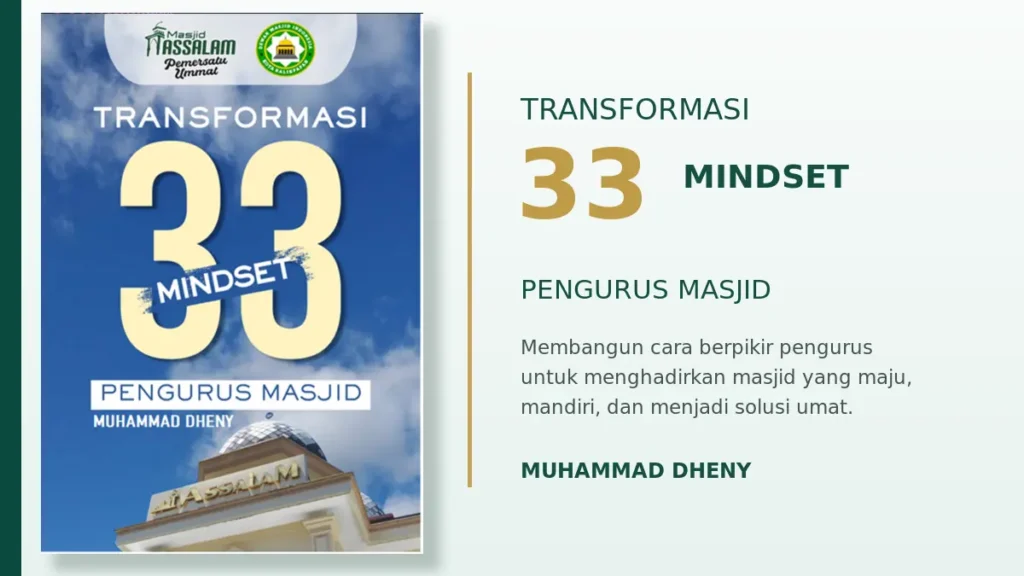
This idea underpins Transformasi 33 Mindset Pengurus Masjid, a book being prepared by Masjid Assalam’s Executive Chairman, H. Muhammad Dheny M. J.
The forthcoming book draws on practical experience, Islamic outreach journeys, and encounters with organizers of mosques and prayer rooms. It aims to help organizers develop the perspectives needed to advance their mosques.
Transformation Begins with the Organizers
Change must begin with the people who manage the mosque. Before planning major programs, organizers need a shared vision of the mosque’s role and direction.
A mosque should do more than open at prayer times. It should be closely connected to congregational life: a place to worship, learn, strengthen relationships, access services, develop potential, and seek solutions to shared problems.
When organizers change their perspective, mosque policies and programs change too. They begin to see worshippers as an extended family to understand, serve, and involve, rather than simply as event participants.
From Maintaining Buildings to Serving Worshippers
Cleanliness, safety, and facilities remain important responsibilities. However, an organizer’s work extends beyond maintaining a building.
Organizers must also consider worshippers’ comfort, service quality, education, youth development, support for families in need, and opportunities for economic empowerment.
A successful mosque is more than one that looks good. Its presence makes a difference to worshippers and the surrounding community.
Organizers therefore need to expand their focus from maintaining facilities to providing meaningful services.
Understanding Worshippers before Planning Programs
Good programs are shaped by more than the wishes of organizers. They should be based on the congregation’s needs and local circumstances.
Organizers can learn about worshippers through visits, conversations, simple surveys, records, and congregational consultations. These processes reveal needs such as Qur’an education, youth activities, healthcare, social assistance, and business development.
This approach makes programs better targeted. Worshippers also feel heard and have opportunities to help shape mosque activities.
Having the Courage to Start and Keep Learning
Mosques do not all have the same resources. Some have adequate funding, while others must begin with limited means.
Limitations should not prevent organizers from acting. Programs can start with simple activities that are most needed and feasible.
Organizers should remain open to learning through study visits, training, reading, discussions, and exchanges with other mosque management teams.
A mosque that keeps learning can adapt more readily and find new ways to serve worshippers.
Managing Mosques Professionally
Enthusiasm needs to be supported by orderly management. Every activity requires planning, assigned responsibilities, financial records, documentation, and evaluation.
Professional management does not diminish sincerity. Good governance helps safeguard the trust placed in the mosque and extend the benefits of its programs.
Organizers need to develop habits such as:
- Holding regular meetings.
- Setting targets and assigning responsibilities.
- Recording income and expenditure.
- Sharing reports openly.
- Documenting activities.
- Evaluating programs.
- Preparing future generations of organizers.
These habits give the mosque direction and reduce reliance on any one individual.
Building Cooperation and Collaboration
Organizers do not have to do everything themselves. Worshippers bring diverse skills, professions, experience, and networks that can support the mosque.
Members of the congregation may have expertise in education, health, technology, business, construction, communications, or social services. These capabilities can become a shared strength when connected and managed well.
A collaborative mindset makes organizers more receptive to ideas and contributions. The mosque develops a sense of shared ownership, beyond the group formally responsible for managing it.
Success Is Measured by More than Funds
Bank balances and donation income are not the only measures of success. Changes in the lives of worshippers and the community matter too.
Useful indicators include:
- More worshippers attending.
- Greater comfort in worship.
- Growing educational activities.
- Involvement of children and young people.
- More volunteers.
- Assistance reaching people in need.
- Growth in business units and economic empowerment.
- Greater trust in the organizers.
Funds raised are a trust. Their value becomes apparent when they are turned into services and benefits.
Reflections from Mosque Outreach
Transformasi 33 Mindset Pengurus Masjid grows out of reflections on outreach journeys from one mosque and prayer room to another.
These journeys have revealed many challenges: limited resources, low participation, underdeveloped programs, and difficulties achieving independence.
Although every mosque’s circumstances differ, change almost always requires organizers to have the courage to reconsider their perspectives.
The book will organize these practical experiences into a set of mindsets that mosque organizers can learn and apply gradually.
Restoring the Mosque’s Role as a Centre for Community Solutions
During the time of the Prophet Muhammad, peace be upon him, the mosque was closely connected to community life. It was a place of worship, education, consultation, social services, and community development.
This spirit is central to Transformasi 33 Mindset Pengurus Masjid. The hope is for mosques to be active not only during congregational prayers but also in providing benefits throughout the day.
With an open, trustworthy, professional, and service-oriented mindset, organizers can help their mosques grow as centres of worship, empowerment, unity, and practical community solutions.
Change does not have to begin with a major step. It can start with a simple willingness to change perspectives before changing programs.