Many mosque organizers have attended training, read books, and studied examples of programs. Yet after gaining that knowledge, a common question remains: where should we start?
Some organizers also face limited staffing, funding, or guidance, or a lack of shared vision among DKM members. As a result, knowledge has not yet become consistently implemented programs.
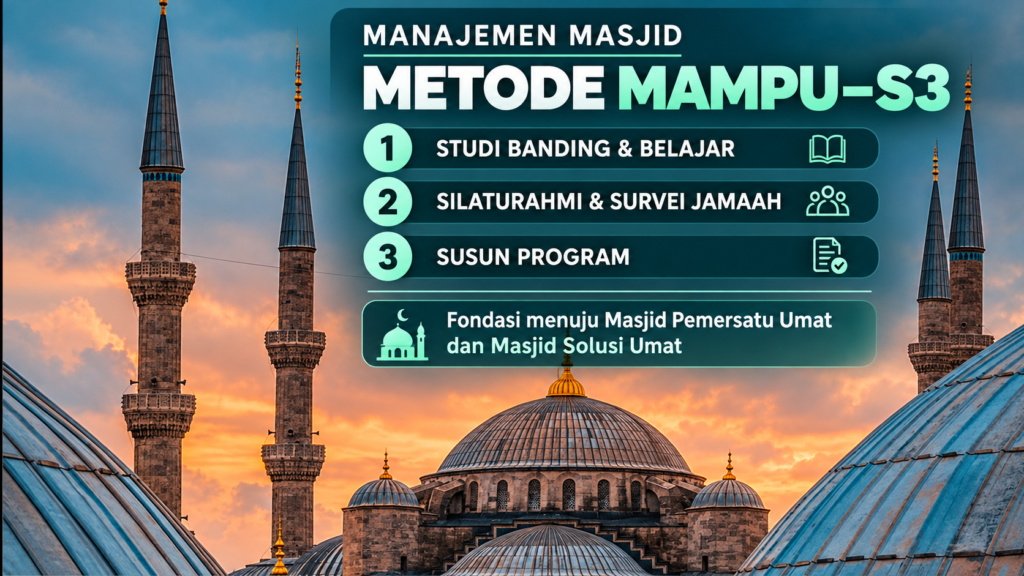
To help organizers identify their first steps, Masjid Assalam introduces the MAMPU–S3 approach to mosque management. It places learning, close relationships with worshippers, and program planning at the foundation of management.
Understanding the S3 Stages
S3 describes three initial steps before launching major programs: study visits and learning, visits and congregational surveys, and then program planning.
These steps help organizers understand the mosque’s actual circumstances. Programs are not created immediately from assumptions, old habits, or the wishes of a few individuals.
1. Study Visits and Learning
Better management begins with a willingness to learn. Learning can take place through DKM training, books, social media, discussions, or visits to other mosques.
Study visits do not mean copying another mosque’s entire program. Organizers need to understand why a program was created, how it works, what resources it needs, and how it affects worshippers.
They can then select practices suited to their own circumstances. A program that succeeds in one mosque may not work in exactly the same way elsewhere.
Learning should also be shared. If only one person understands the direction of change, implementation will be difficult. Training and study-visit findings should therefore be discussed in management meetings so that the whole DKM understands the aims.
Regular meetings can align perspectives, assign duties, discuss obstacles, and evaluate existing programs.
2. Visits and Congregational Surveys
Mosques exist to serve worshippers and local people. Organizers therefore need to know whom they serve and what those people need.
They can begin with smiles, greetings of peace, and friendly acknowledgement. Consistent contact strengthens the relationship between the DKM and the congregation.
Alongside everyday conversations, organizers can conduct simple surveys to understand circumstances, interests in mosque activities, guidance needs, social challenges, and community potential.
Organizers also need to consider different groups. Older people, young families, teenagers, children, people with disabilities, and residents with limited means have different needs.
Survey results provide important input for program decisions. Activities then respond to real needs rather than organizers’ assumptions alone.
3. Planning Programs
After learning and understanding congregational needs, organizers can begin planning programs.
Not every program needs to start on a large scale. Organizers can select one or two activities that are most needed and feasible.
Options include thematic study sessions, children’s and youth activities, food distribution, community work, social services, skills training, healthcare, and economic empowerment.
Each program needs clear aims, intended participants, a responsible coordinator, a schedule, funding requirements, and measures of success. Duties should also be assigned so that implementation does not depend solely on the DKM chairman or one individual.
After implementation, organizers should evaluate attendance, benefits, challenges, expenditure, and necessary improvements.
Growing Gradually
MAMPU–S3 encourages realistic, gradual development. Once programs are running, organizers can strengthen the mosque as a source of unity and community solutions.
Later stages can focus on economic empowerment, business development, improved services, and facility development.
Physical development remains important, but should go alongside strengthening the mosque’s functions. A thriving mosque is measured by growing participation and community benefits, not its building alone.
Simple Steps to Begin
Organizers can start by holding an internal meeting, choosing a mosque for a study visit, and preparing a simple congregational survey.
The findings can then be discussed to select one priority program. It should be implemented, recorded, and evaluated before further activities are added.
Change does not have to wait for substantial funding. A willingness to learn, work together, and listen to worshippers is essential to improving mosque management.
With clear stages, a mosque can grow into a centre of worship, learning, service, and community empowerment.